
This month, a deep-dive into how Bitcoin mining could rescue global ESG investing, while ESG investing could return the compliment by giving Bitcoin an almighty adoption (and price) boost.
More about that in our Main story section below. But first, here’s an update on what’s been happening in the last couple of months that we think is advancing Bitcoin adoption.
Top Picks
Why the mining network keeps getting cleaner without anyone mandating it
Cambridge now puts the Bitcoin network at 59.4% sustainable energy. No government mandated that and no subsidy paid for it. New peer-reviewed research just released points to the economics underneath it.
Economist Simon Hutabarat took California’s hour-by-hour electricity prices. He matched every connection point on the grid to the kind of power plant behind it. Then he worked out what a miner at each one would pay.
A miner next to a wind farm can survive a Bitcoin price 45% lower than one running on gas. Put the other way, the gas-powered miner needs Bitcoin at 1.8 times the price just to stay alive.
So every price drop pushes out the miners with the highest electricity costs. The gas-powered miners switch off first. The ones sited on wind and solar are still running when the market turns.
The paper notes:
“mining can use surplus renewable energy during off-peak hours, reducing fossil dependence and potentially promoting renewables”
“mining loads can absorb excess renewable energy and enhance grid resilience”
“price-responsive Bitcoin mining can absorb excess renewables at low/negative prices, reducing curtailment” (waste of wind/solar energy)
It is published in Renewable Energy, which carries an impact factor of 9.1 and sits in the top 3% of journals worldwide.
Bitcoin can help rebuild Ukraine’s broken power infrastructure
Cheap, stranded power that miners can switch on and off at will isn’t only a California story. Nowhere is that clearer than in Ukraine, whose grid has been battered since Russia’s invasion. Despite the destruction, its three working nuclear plants can still produce 7.5 to 8.5 GW. The problem is that the lines that carried that power across the country have been destroyed, and rebuilding them would cost more than $10 billion and take 3-5 years.
A new Bitcoin Policy Institute paper by Jacob Langenkamp offers a way out: direct 10% of that stranded power, 750-850 MW, to containerized Bitcoin miners at the plants. By his estimate, that would earn ~$1 billion over five years, enough to service up to $4 billion of reconstruction debt. These mining units could be up and running in 6-9 months.
Bitcoin mining is the one customer that will take that power anywhere, at any hour. Call it the buyer of last resort. The research is now there for any government ready to use it.
Trailblazers
The idea of putting Bitcoin mining heat to work in our homes keeps gaining ground. A wave of engineers is building products around it, and this month’s trailblazers are proof of that.
First up is Finland’s SunBit, which has built a Bitcoin Boiler that plugs straight into a home’s existing water-based heating system. Instead of fans blowing hot air out of a vent, liquid cooling carries the miners’ heat directly into the radiators and pipes the house already has. This isn’t a prototype either: 30 systems are already running, nearly all of them in Finnish homes.
Next, Heatbit has unveiled Bitwater, a water heater element that mines Bitcoin. It replaces the metal heating element inside an ordinary electric water tank with Bitcoin mining chips, screwing into a standard fitting. The water cools the chips, and the chips heat the water simultaneously. Preorders are open now, with first units due in early 2027.
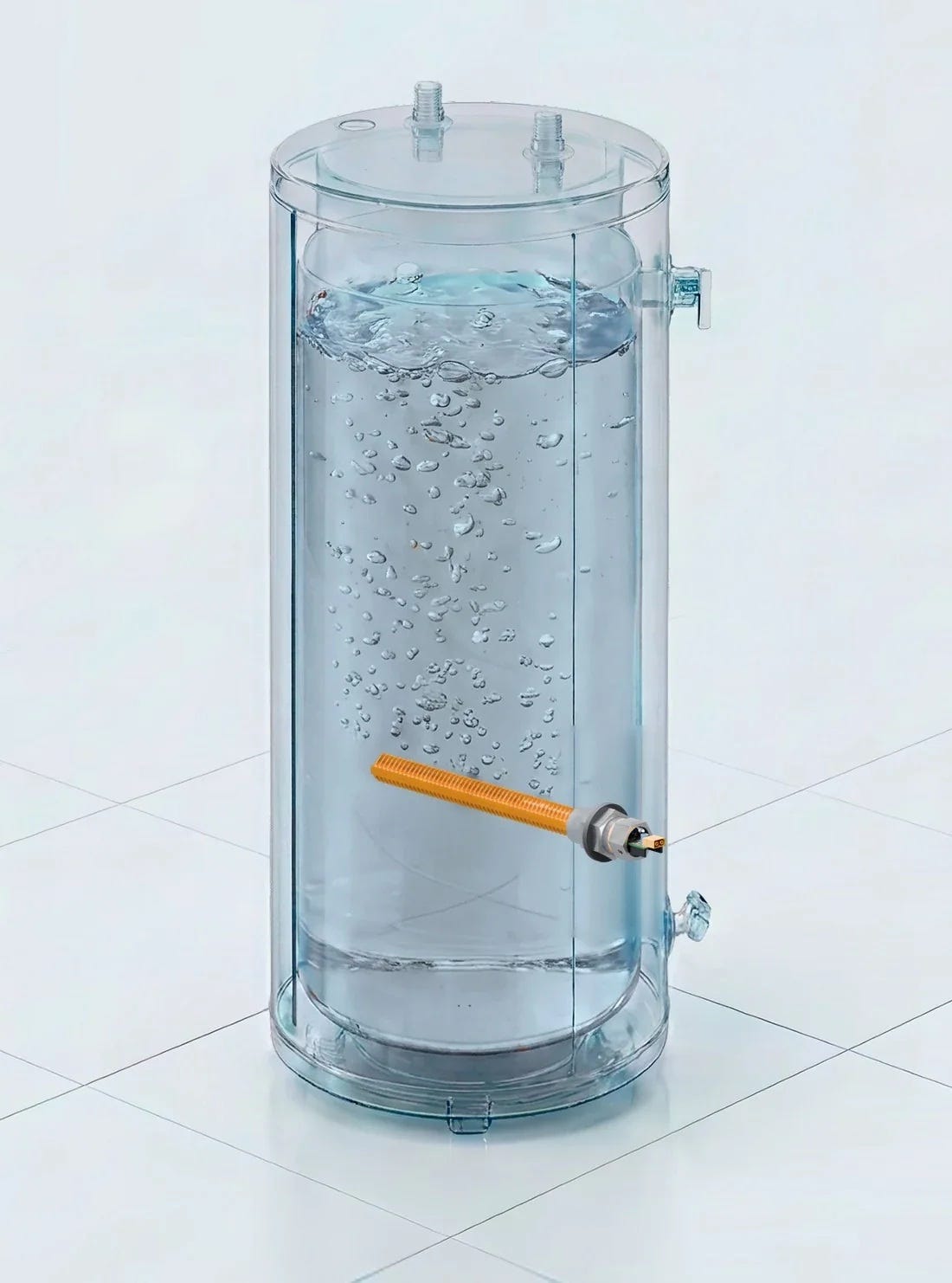
Lastly, there’s Softwarm, a company based in Challis, Idaho, which has taken two miners, sunk them in a tank of oil and piped their heat into a building’s concrete slab, turning the whole floor into an underfloor radiator.
These innovations show that heating homes with Bitcoin mining is no longer theoretical. It is happening at an increasing commercial scale, with more novel applications announced each quarter.
Feature
Listen to my conversation with Alex Stanczyk on The Crucible. We dig into turning landfill methane into Bitcoin, how it’s financed, and the talks I’m having with energy ministers from Pakistan to Latin America. You’ll also hear why just two score landfills could make Bitcoin mining carbon negative. Watch (~50 min).

Main Story
Bitcoin adoption advances when it solves problems no other technology can. One big problem Bitcoin mining solves is that most ESG funds around the world are struggling to generate meaningful returns and have meaningful impact, even though the demand (money) for such funds is there.
As evidence of this, sustainable fund launches in Europe have just hit a record low. The money has not left: American sustainable funds took in close to $3 billion over the same 3 months. The constraint is that a manager has to choose between a return they can prove and an environmental benefit they usually assert, but seldom measure.
I did a search of ESG funds recently. Of the 71 ESG I found, only 25 of them reported on the level of emissions their fund kept out of the air, per $ million invested.
The chart below shows the highest five who measure their emission reductions per $million invested, charted against our own Bitcoin mining fund CH4 Capital.
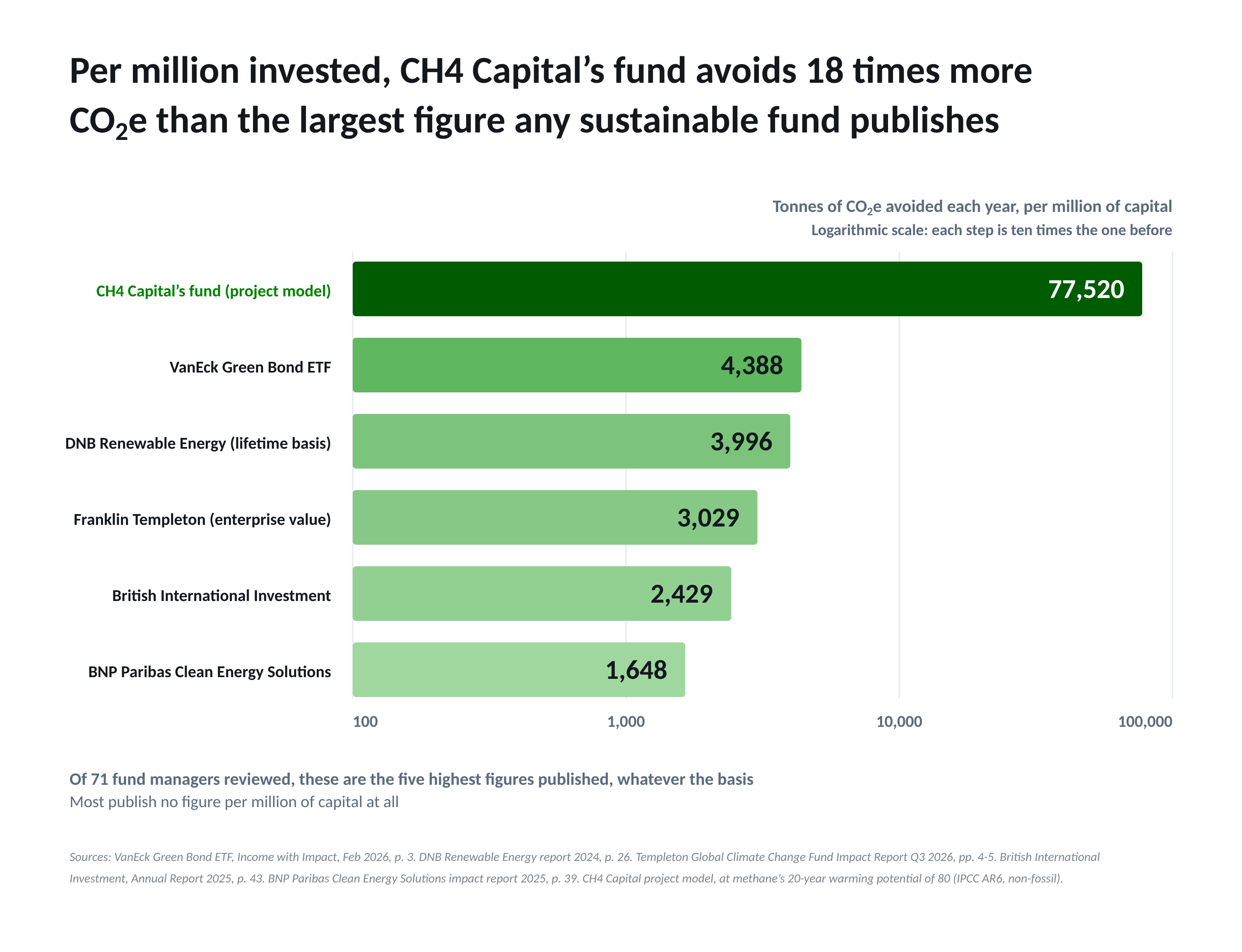
The next best I found is VanEck’s green bond fund, at 4,388 tonnes a year per million invested. Ours is 77,520, which is 18 times as much, hence the chart’s log scale.
Why a dollar goes so much further here
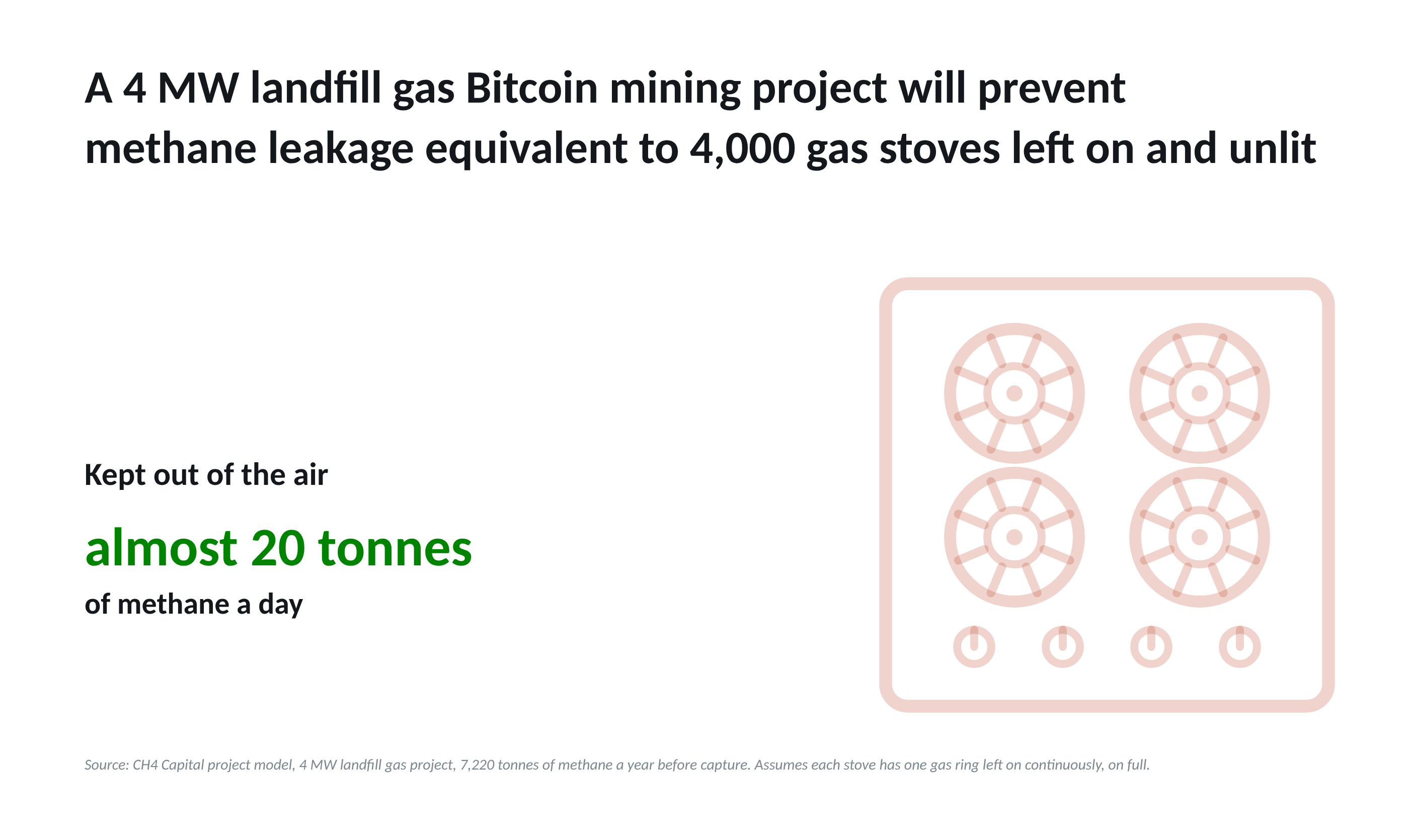
Methane traps 80 times the heat of carbon dioxide over 20 years, so destroying a small mass of it does a large amount of work.
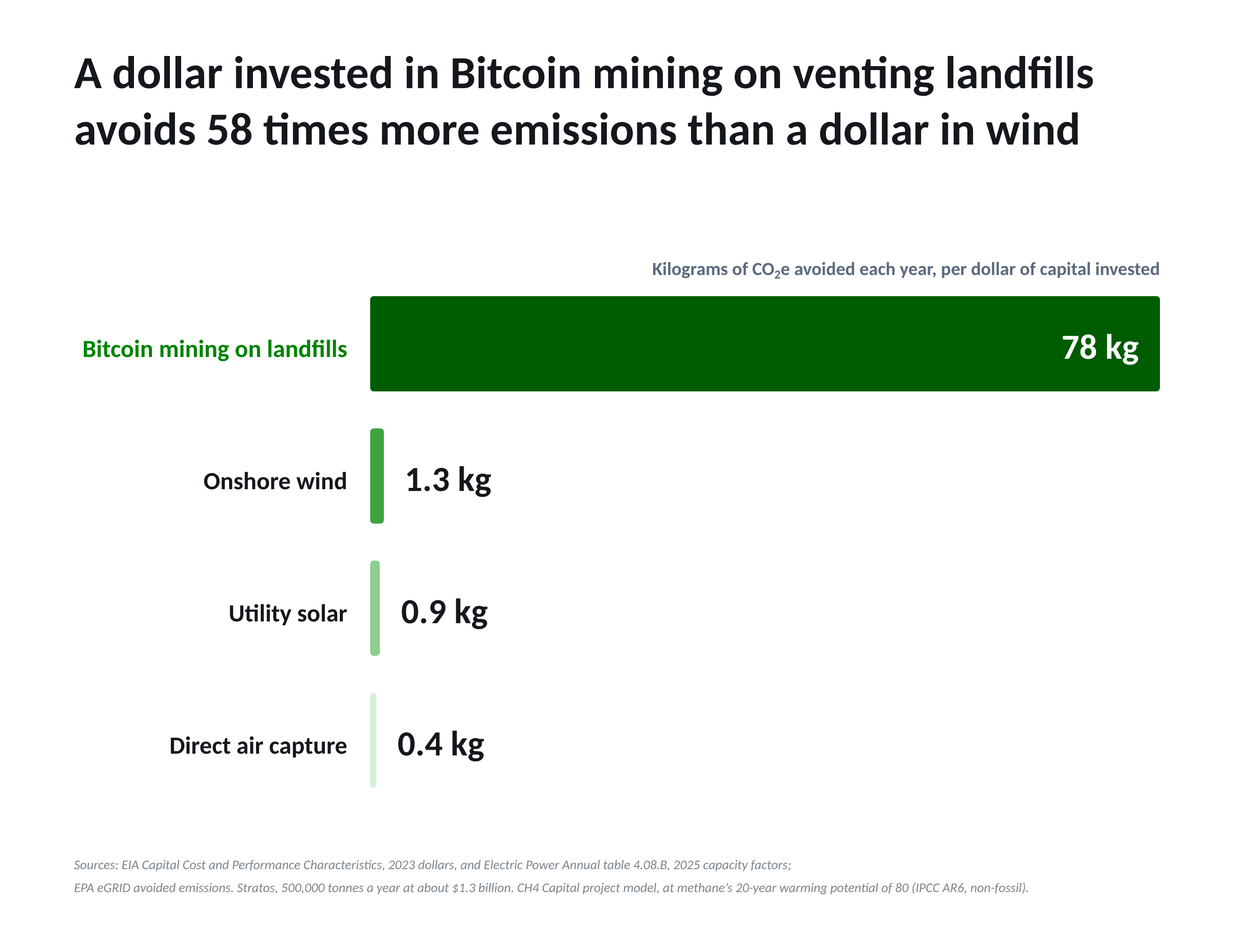
Windpower is great, and we need more of it on the grid. It stops carbon being made, whereas we destroy a gas that is already about to be emitted, which costs a lot less per tonne for the simple reason that no other technology can do it profitably.
Bitcoin mining is economic at 2 MW, installs in months, and pays cash for the power as it is produced. It also means a small amount of capital destroys a lot of carbon.
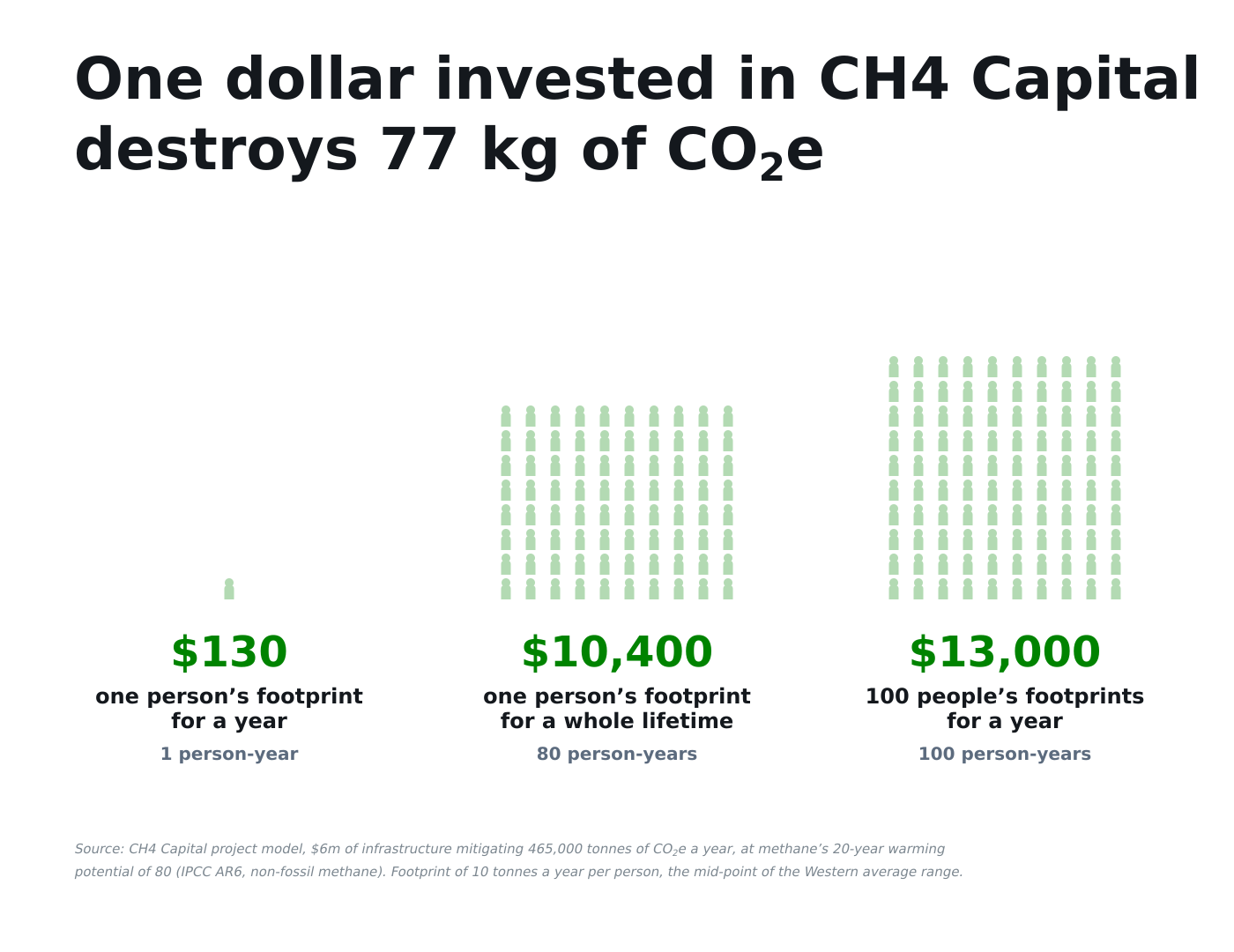
It also makes more sense at an individual level. To the many who feel guilt about their personal carbon footprint, knowing a whole year of it can be offset for $130 is a very appealing thought. $10,400 covers one person’s whole lifetime carbon footprint. Unlike past offset schemes, it involves much more impact for the same dollar amount, doesn’t rest on saving a forest from deforestation that may or may not have been left alone anyway, and actually generates a return.
How landfill Bitcoin mining returns compare
OK, so the environmental benefit of a landfill Bitcoin mining fund is significantly higher and more measurable, but what about its returns compared to other ESG funds?
Impax’s listed trust returned 8.6% a year over 3 years, against 18.3% for its own benchmark, the MSCI All Country World Index. Over 5 years it returned 1.5% against the index’s 11.9%.
Impax’s US fund did better, 16.67% over 3 years.
Infrastructure funds, on Hamilton Lane’s published net targets, aim for 6-8% on core assets, 8-10% on core-plus, 10-12% on value-add and 12-15% at the opportunistic end.
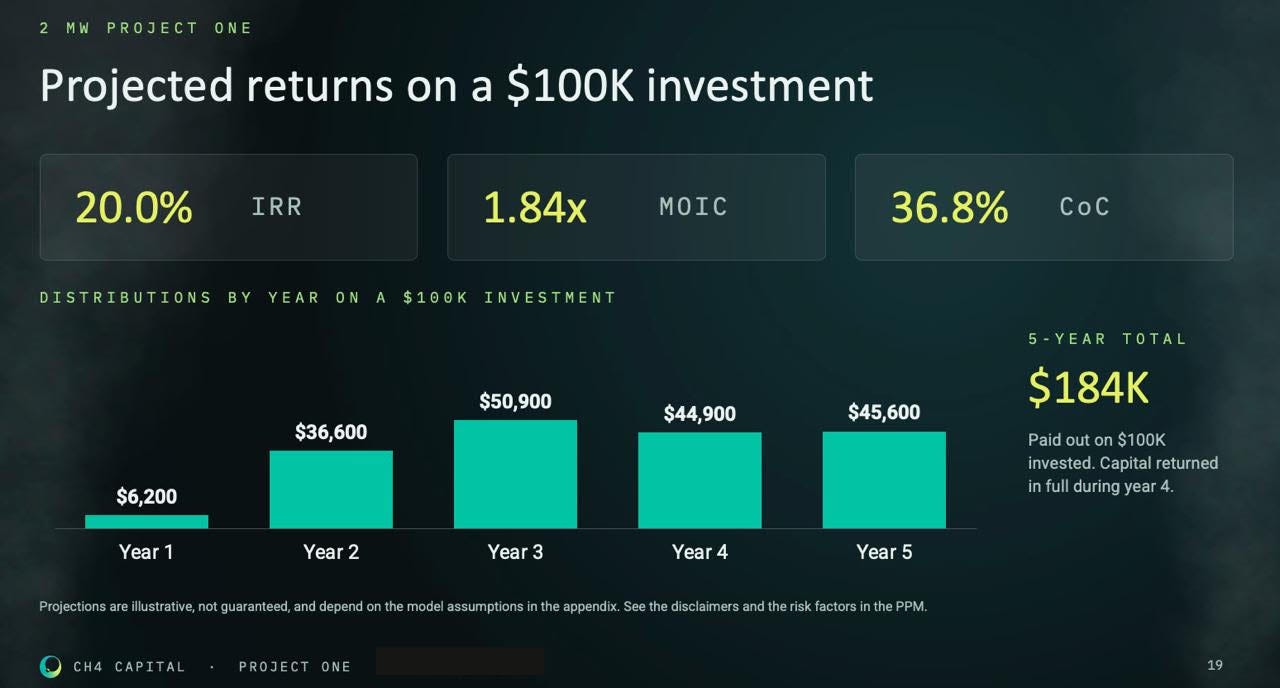
Our first project is projected to return at an IRR of 20% based on our models, with the original capital back in year 4.
$100,000 pays back $184,000 over 5 years. For context: IRR weighs the timing as well as the amount: cash returned in year two can be put to work for three more years, so it is worth more than the same cash returned in year five.
What diverting 0.1% of climate investment does
Sustainable funds held $16.7 trillion at the end of 2024, on the Global Sustainable Investment Alliance’s most recent count. 0.1% of that, routed to landfills, would build up to 11 gigawatts of mining, 2,700 times the size of our first site.
Those projects would destroy 16 million tonnes of methane a year, which at methane’s 20-year warming potential is 1.29 billion tonnes/yr of CO₂e. That is 3.3% of everything the world put into the air from energy last year, from 0.1% of the money. And the other 99.9% of capital isn’t exactly mitigating the remaining 96.7%.
The amount of avoidable warming this would reduce is 0.024°C, or one forty-second of a degree. This may sound small, but it is 14% of the Global Methane Pledge’s entire methane reduction ambition, achieved through one technology operating on one methane source.
But what does this do for Bitcoin?
0.1% of the world’s ESG investing into Bitcoin mining projects on landfills would of course improve the brand of Bitcoin immensely among Bitcoin’s potential new adopters. But it does something more significant: it gets $16.7 trillion of ESG capital comfortable with the idea of investing into Bitcoin itself, particularly as Bitcoin starts to rapidly pay off its carbon debt the same way the photovoltaic industry did in 2013, only considerably faster (the photovoltaic industry took 59 years to pay off its carbon debt).
Nobody has to take my word for it
Writing 2,500 years ago, Aeschylus said of the seer Amphiaraus:
“he does not wish to seem the best, but to be the best.”
Today the sustainable investment industry has a hundred ways to seem it, but only 25 of 71 fund managers willing to publish numbers that show it. And even then, only five publish their methodologies. By contrast, on landfills with a Bitcoin mining project there will be meters showing, in real time, how much methane is travelling into generators instead of into the air.
The ad campaign has passed its first goal
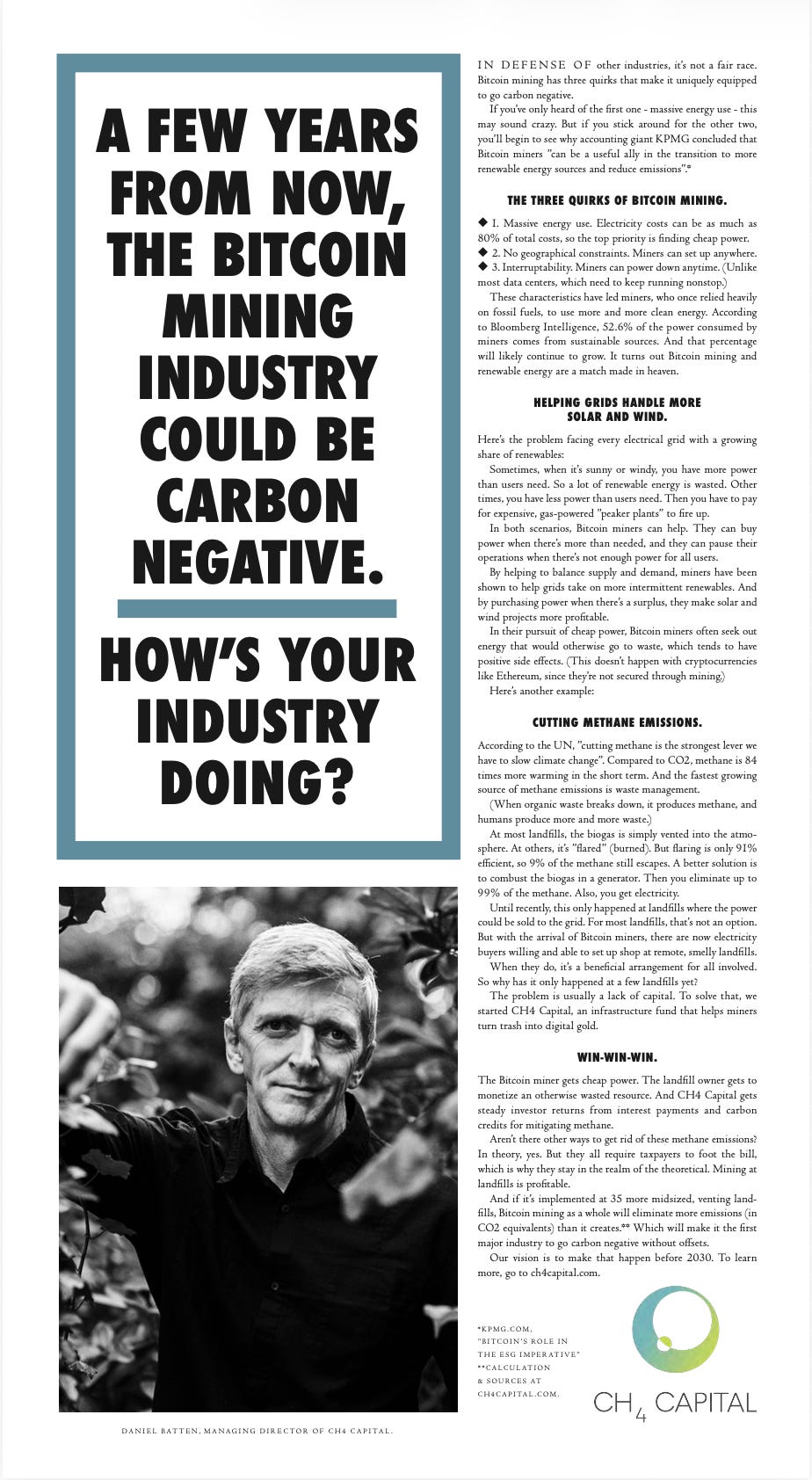
I asked you 9 days ago to help put Bitcoin’s methane reduction story in front of New York Times’ readers. The first target was $2,000, and we are now at $3,090, which is 155% of it.
Most of that came from subscribers to this letter. So a big thank you!
Also, 74.3% of that arrived in sats, mostly from people who have never met me. A full page in the NY Times costs $70,000, so we are 4.4% of the way there.
If you’d still like to give, you can do so here.
👉👉 Give in Bitcoin
👉👉 Give in Fiat
Keep giving, keep sharing.
One more thing…
Two people wrote last week offering sizeable donations. If you were one of those people and heard nothing back, I did reply but my email probably did not arrive. Reply to this email and it will reach me, and add this address to your safe senders while you are there.
PS: after our site visit to our first landfill last week, we realized there is more methane than we expected.
We had closed our capital raise for project 1 … until we conducted our final site visit and found we have the potential to do a larger project to capture the extra methane available. We also found there is a school and a hospital near the landfill. Based on that we’ve resolved to make our first project 4MW rather than our initial 2MW plan, so we clean up as much of the air they are breathing as possible. So we’re re-opening the fund for project 1. So if you’re an accredited investor and you’d like to know more about the fund, reply here.
Where this letter discusses CH4 Capital, it is for information only and is not investment advice. Any offer is made solely through CH4 Capital’s formal offering documents, to verified accredited investors. Investments of this kind are illiquid and speculative: the fund’s capital is exposed to the credit of the projects it finances, and an investor should be able to bear loss of capital. Figures for those projects, including any projected return, are projections from our model, not results, and rest on assumptions including gas volumes, capture rates and Bitcoin’s price, which is volatile. Third-party figures come from the sources named and are not independently verified.