
Dear Subscriber,
Three conversations are happening right now about the future of electricity grids. They’re happening in parallel swinlanes, without awareness of each other. This lack of awareness won’t last forever. When these three conversations intersect (and for reasons I’ll go into in my letter it is a “when” not an “if”), it will change how the world understands what Bitcoin is for.
More about that in our Main story section below. But first, here’s an update on what’s been happening in the last couple of weeks that we think is advancing Bitcoin adoption.
Top Picks
Energy surplus is a challenge several countries now face, even as a majority of nations don’t produce enough power for their own consumption. In Brazil, solar companies are routinely forced to switch off their power stations when the grid cannot absorb their output. Companies such as Thopen already turned to Bitcoin mining to put that stranded energy to work. Colombia faces the same abundance problem: a 2024 World Bank report found the country generates 75% of its electricity from renewables — more than twice the global average.
Now Colombian President Gustavo Petro, borrowing a leaf from his neighbors, has begun promoting Colombia’s Caribbean cities as Bitcoin mining hubs powered by the country’s surplus renewable energy. Notably, Petro has also floated giving the Wayúu community, Colombia’s largest Indigenous group, co-ownership of any mining projects that emerge. When an environmentalist head of state champions Bitcoin mining as both a solution to his country’s energy surplus and a tool for Indigenous economic empowerment, the old “Bitcoin vs. the environment” narrative loses yet more ground.
Trailblazers
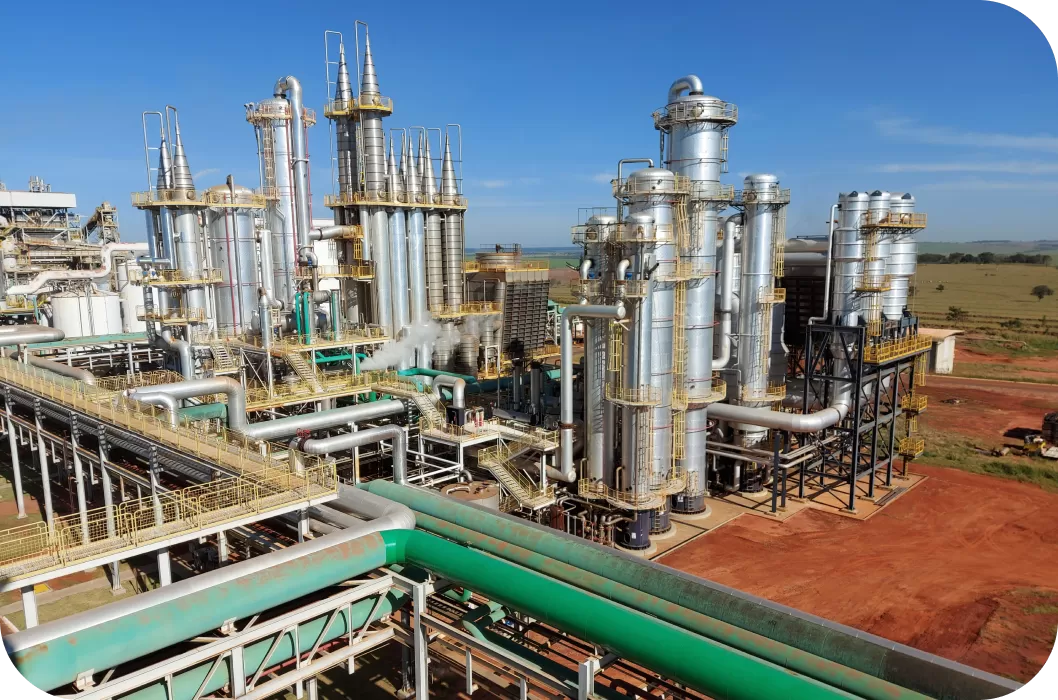
Besides being an energy-surplus country, Brazil is also the world’s largest producer of sugar and second-largest producer of ethanol, both products of sugarcane processing. In sugarcane factories, the most significant byproduct is bagasse, the fibrous residue left over after the crushing of sugarcane stalks. Mills routinely burn bagasse to generate steam and electricity for their own operations, and often the energy produced exceeds what they can use. So what happens to the surplus?
Well, Adecoagro is launching a Bitcoin mining operation aimed at putting this otherwise wasted energy to work. The pilot, a 10 MW facility based in Ivinhema with roughly 1,280 mining machines, will serve as a commercial test of whether mining can scale as a complement to existing power sales across the company’s entire platform, which holds more than 230 MW of renewable generation capacity across South America. In addition, the company is weighing adding mined Bitcoin to its balance sheet alongside farmland as a long-term store of value. Farm waste in, sound money out.
Meanwhile in Wheatland County, Alberta, a 750 kW solar installation paired with a Bitcoin mining operation housed in a single 40-foot container is moving ahead after the county council voted in support of the development. The solar facility is intended to offset the mine’s energy consumption, with the potential to supply surplus energy back to the grid.
What’s most exciting about this project is its demonstration of what distributed mining is all about. It’s not only large companies and nation-state projects that can capture Bitcoin mining’s energy and economic externalities, even small installations backed by rural county councils can make mining’s benefits attainable to anyone willing to give it a chance.
Features
Watch my opening remarks at the FREE Energy Summit in Lisbon, kicking off an event dedicated to the real-world projects proving how Bitcoin mining can power Europe’s energy transition. Watch (~10 min).
At the MadBitcoin Summit in Madrid, I gave a keynote on why Bitcoin mining is the “almighty shock absorber” our increasingly fragile grids need and what last year’s Iberian Peninsula blackout revealed about the bee, the hornet, and the future of energy. Watch (~16 min).
On The Bitcoin Layer, Nik and I unpack the collision between AI, the power grid, and Bitcoin mining: including the Swedish miner getting paid at negative two cents per kWh and why Bitcoin may solve an energy problem before the world realizes it solves a monetary one. Watch (~36 min).
I also joined Ricky Zhang on his new podcast, Age of Abundance, to explore how Bitcoin mining serves as a uniquely flexible load balancer for grids strained by renewable energy, and why reaching the mainstream requires leading with local utility rather than ideology.
Lastly, and most recently, I sat down with Paula on The Bitcoin Edge to dismantle the $6 billion anti-Bitcoin campaign. We break down why every major attack against the network doesn’t just fail, it actually makes Bitcoin stronger.
