
Bitcoin’s hashrate has always done the same thing through every bear market since 2009: gone up. But its 30-day average has now been trending down for 259 days.
You’ve seen the headlines: “Bitcoin mining out, AI datacenters in.” That’s where the analysis tends to stop. As a result, the question “is this bad or good for Bitcoin?” is never asked. Rather, the reader is encouraged to think it must be bad for Bitcoin, with headlines like this. Yes, that’s a real headline.

There is another problem with the media accounts: no data analysis showing what the projected transition from Bitcoin to AI will look like.
This matters, because the BTC→AI datacenter migration has two positive repercussions for Bitcoin and one tradable one for Bitcoiners (to give a hint: hashprice can now be sold forward).
So I counted up what’s happening on the grid of Texas (ERCOT), because that’s where the world’s biggest concentration of Bitcoin miners live … for now.
Pretty charts below. The one below shows where in that migration we still are.
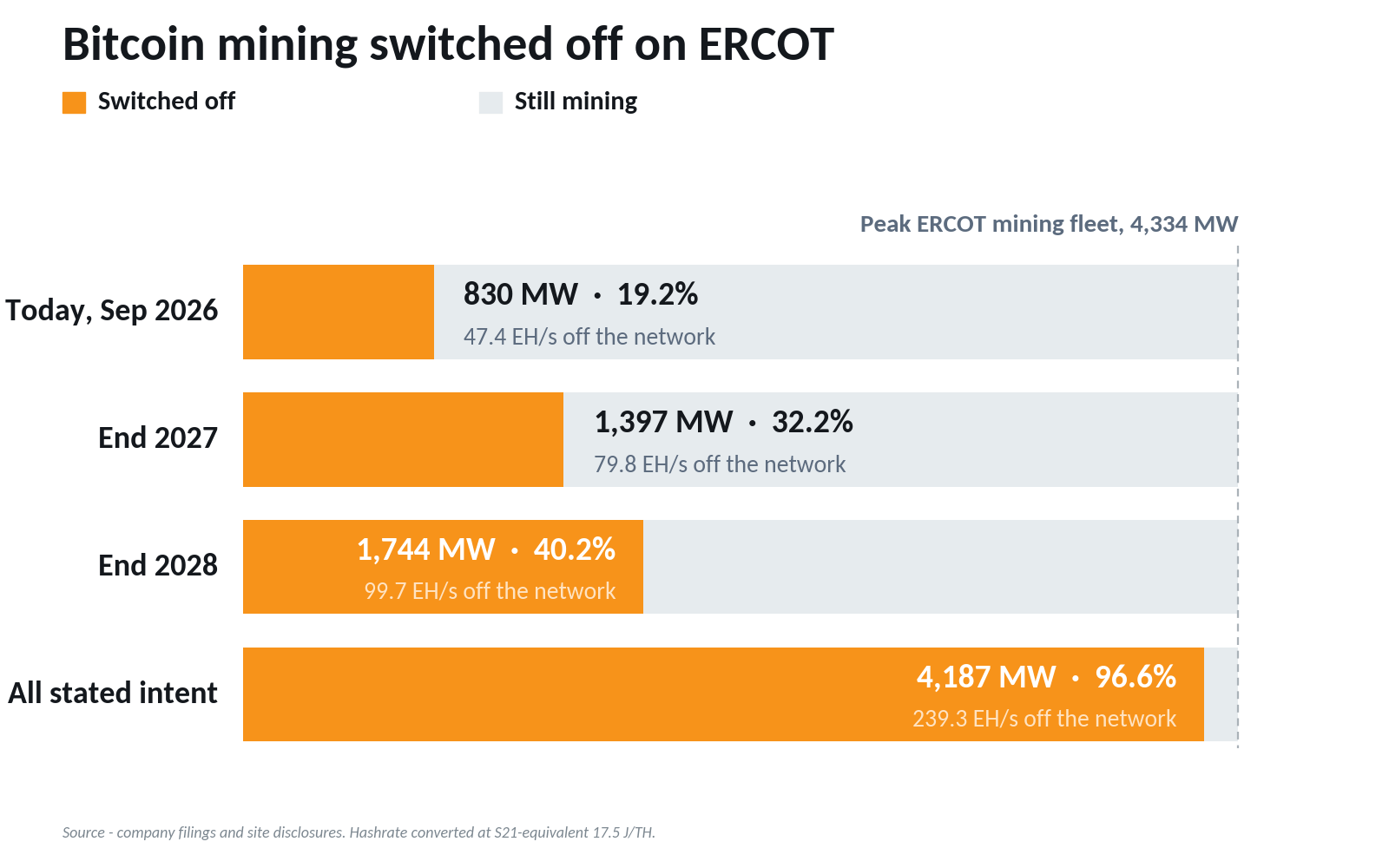
1. The Bitcoin mining switch-off has started
This chart says, we’re under half way through the contracted transition from Bitcoin mining→AI and under 20% of the way through the commitment to transition that Bitcoin mining companies on ERCOT have publicly made to their shareholders.
2. New AI datacenter load is just the start
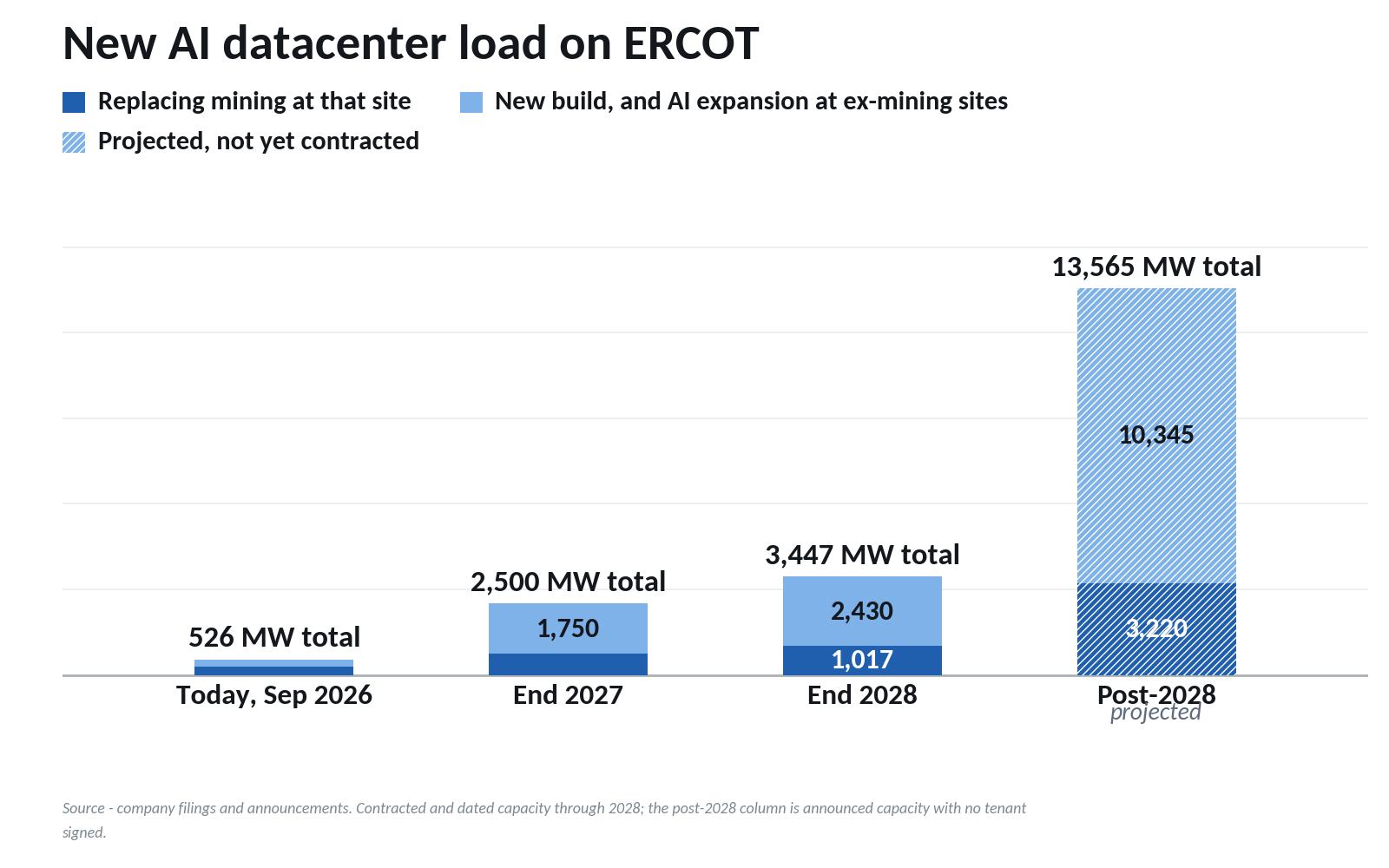
Next, we can see that AI transition is happening in two phases. The first and easy phase is to convert an energized site that already has land, and a power contract from Bitcoin mining to AI. The harder second phase is greenfield builds.
This year, most AI datacenters are conversions, but that ratio is set to flip next year.
In summary: the ERCOT grid is losing a lot of flexible load, and scheduled to gain an enormous lot of relatively inflexible AI datacenter load. 10,345 MW is enough electricity to power 6.7 million Texan homes for a year. Unlike Bitcoin mining, it cannot power down at a moment’s notice, so it does compete with residential users.
3. The net position change - a concern for Texas
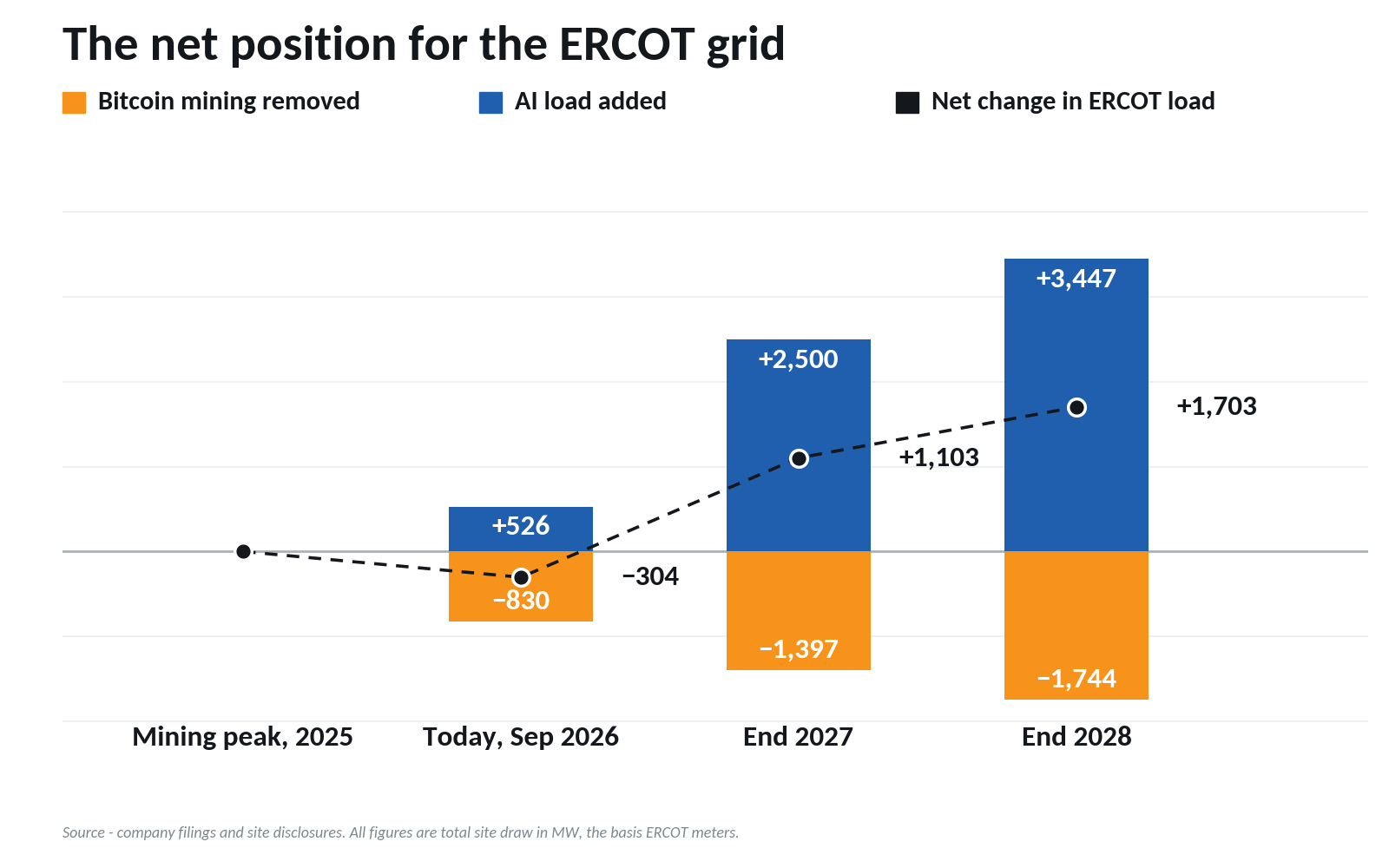
Putting these 2 charts together, here’s the cumulative position, based on actual commitments. The dotted line is the net change in grid load from the 2025 Bitcoin mining peak.
This chart also tells us why there are no grid stability issues yet. Even though the ERCOT grid has less flexibility, it also has overall got less load (temporarily). That all changes next year.
Storms say “give me long duration flexibility”
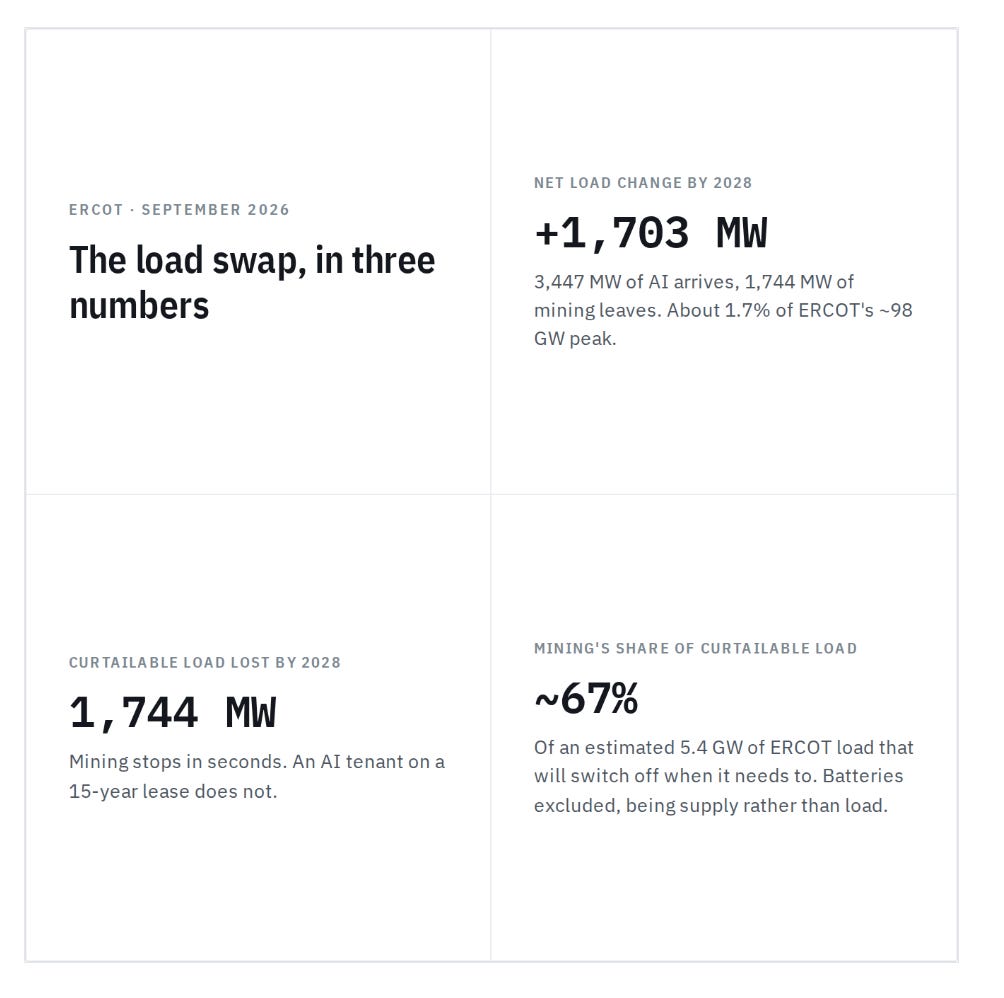
Bitcoin mining is 67% of ERCOT’s entire flexible load, and the grid will lose 40% of it by 2028 (and most of it if every Bitcoin mining company on ERCOT does what they said they would). As I’ve covered in my May newsletter, this creates a looming grid stability issue. With more AI (inflexible load), coming onto the grid, the grid needs more flexibility, but it’s getting less. Batteries cannot be the solution, because they deliver only up to 4 hours of discharged power back to the grid.
For context: past peak weather events in Texas (such as Winter Storms Uri in ‘21, Elliott and Landon in ‘22, Heather in ‘24 and Fern in Jan ‘26, plus the 2023-2026 summer heat waves) required multiple days of flexible load coming offline in order to stabilize the grid. Batteries can’t do that. Bitcoin mining could. See the problem?
Why this is good for energy mix + decentralization
While this is a problem for one grid, it has some big positives for Bitcoin. As hashrate comes off the ERCOT grid (~40% clean energy), it is going disproportionately to places with higher clean energy mix as we can see in the chart below.
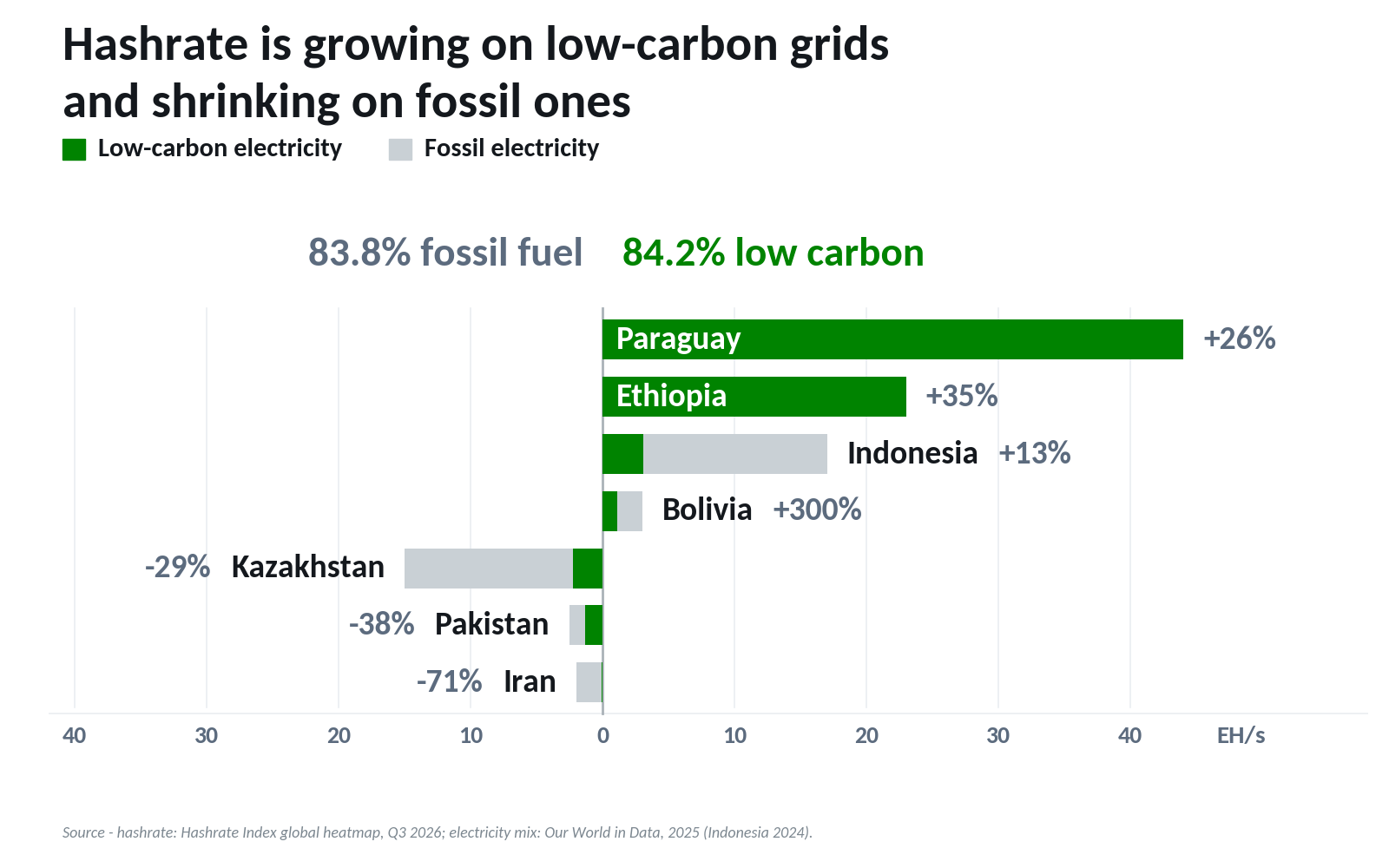
At the same time, you also have the overall hashrate among large public US-miners falling, while small-midsized non-US hashrate is rising. I’ve also seen evidence there’s been a small rise in small-mid US hashrate, but more on that in a future letter.
The combination of less geographic centralization and less pubco centralization, is one that most Bitcoiners will deeply appreciate.
Why this is starting to matter financially
Because it’s starting to become tradable data.